Two ways to start, from Unity Renewables, the Rochester, NY company that builds, delivers, and services the PowerBox 10K. Pick the one that fits what you are building.
Portable box
The NanoGrid Mobile Blueprint
Step-by-step plans to build the PowerBox 10K, a rolling 10 kWh, 48 V LiFePO4, 4,500 W, 120 V system for a food truck, a job site, or an event.
$67one-time for the Plans Edition
The written plans, wiring and layout diagrams, and the parts list with links for the enclosed build, as a PDF.
For a van, truck, trailer, cart, home backup, or a box of a different size, at 12, 24, or 48 V. You pick the parts. It sizes every wire, fuse, breaker, switch, and bus bar, then lists every part you need.
$79Online Edition, one-time
Sign in with your Payhip key in one browser profile at a time. The online edition needs an internet connection. No installation or subscription.
Want both? The Complete Builder Kit has all five builds and the System Designer, for $397.
Portable box
Based on the PowerBox 10K.
The NanoGrid Mobile Blueprint walks through the enclosed, rolling build behind the PowerBox 10K: the parts, the wiring, the torque values, and the inverter settings we use on units in the field.
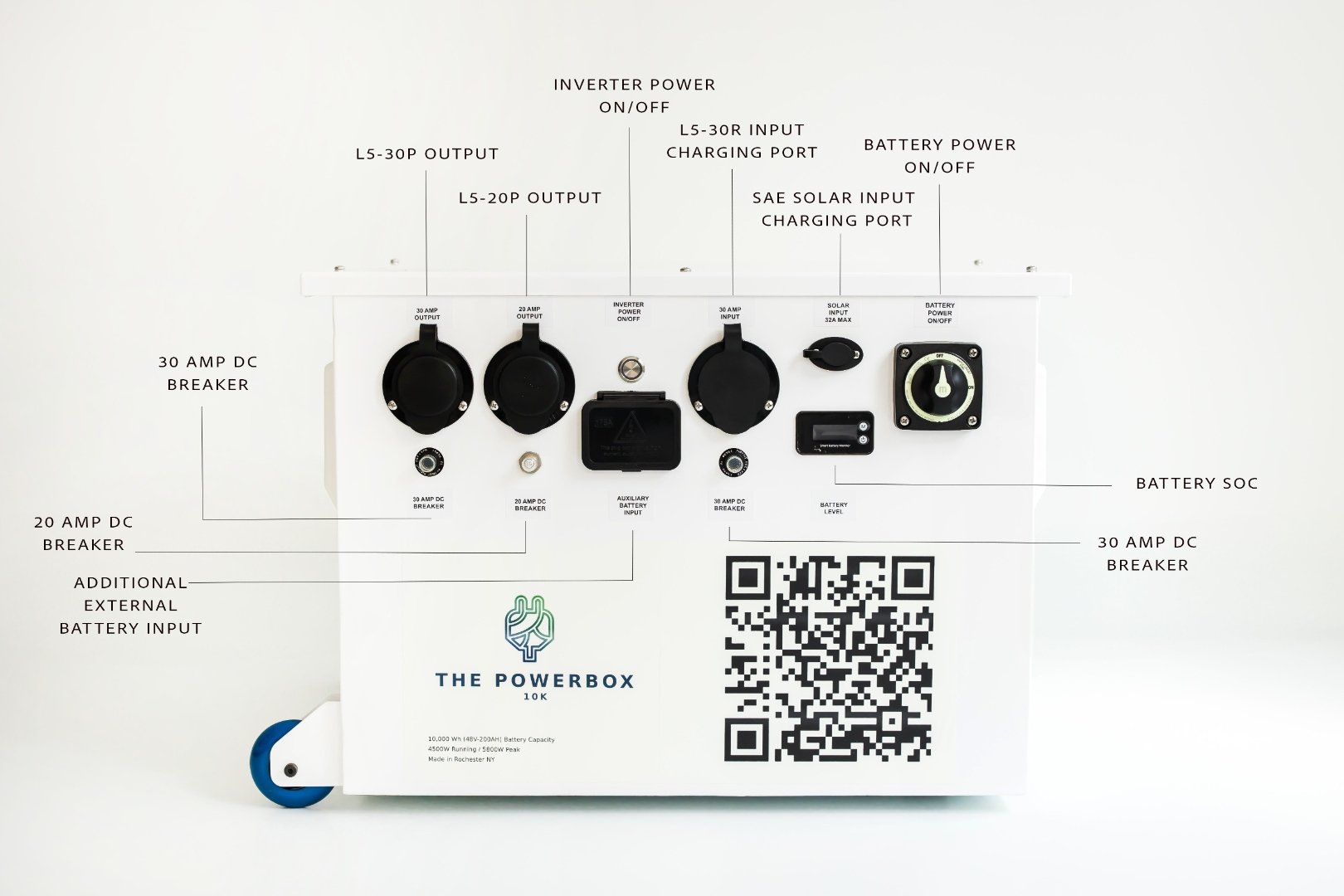
The PowerBox 10K front panel. The Blueprint shows how to build and wire every port.
Battery bank
10.24 kWhTwo 51.2 V, 100 Ah LiFePO4 batteries in parallel
Inverter/charger
4,500 WPure sine wave, 120 V, 6,750 W surge for 5 seconds
AC outlets
30 A + 20 AL5-30R and L5-20R locking receptacles, each on its own breaker
Charging
AC + solarShore power, a generator, or a household outlet, plus solar panels
Weight
About 210 lbThe PowerBox 10K, on locking casters with two handles
What's inside
Twelve chapters, from the first safety rule to the last setting.
Every step is written for someone building a system like this for the first time, with the ratings each part needs so you can substitute when a part is out of stock.
01Safety firstThe rules for a 48 V lithium bank and 120 V AC, before you touch a part.
02How the system worksThe DC side, the AC side, controls, and grounding, in plain language.
03Choosing the core partsBatteries, inverter/charger, and solar controller, and what each must be rated for.
04Parts listEvery part with its required rating, a recommended pick, and a budget pick where one exists.
05Enclosure and layoutWhere everything goes, airflow, service access, and casters rated for the weight.
06Tools and torqueThe tools you need and a torque value for every connection.
07Build stepsDC wiring, AC wiring, controls, grounding, labels, and the 30 A cord, step by step.
08GroundingStandalone use versus prewired trucks, plus GFCI protection for job sites.
09Commissioning and settingsFirst power-up, every inverter and solar setting, battery balancing, and solar sizing.
10The other four buildsVehicle install, open rack, wall-mount backup, and half-size 5 kWh. In the Complete Builder Kit.
11Runtime, use, and careRuntime estimates, cold weather, external batteries, and upkeep.
12TroubleshootingWhat to check, in order, when something does not work.
Inside the plans
Diagrams you can build from.
Each build has its own diagram page, drawn from the way we wire PowerBox units in our shop: every cable size, fuse, breaker, and bus bar connection, with the grounding shown for standalone use and for prewired trucks.
Wiring and layout pages for the enclosed build
A parts list with links, a recommended pick, and a budget pick
Inverter and solar charge settings, with the reason for each one
Step-by-step build photos in the Blueprint and the Complete Builder Kit
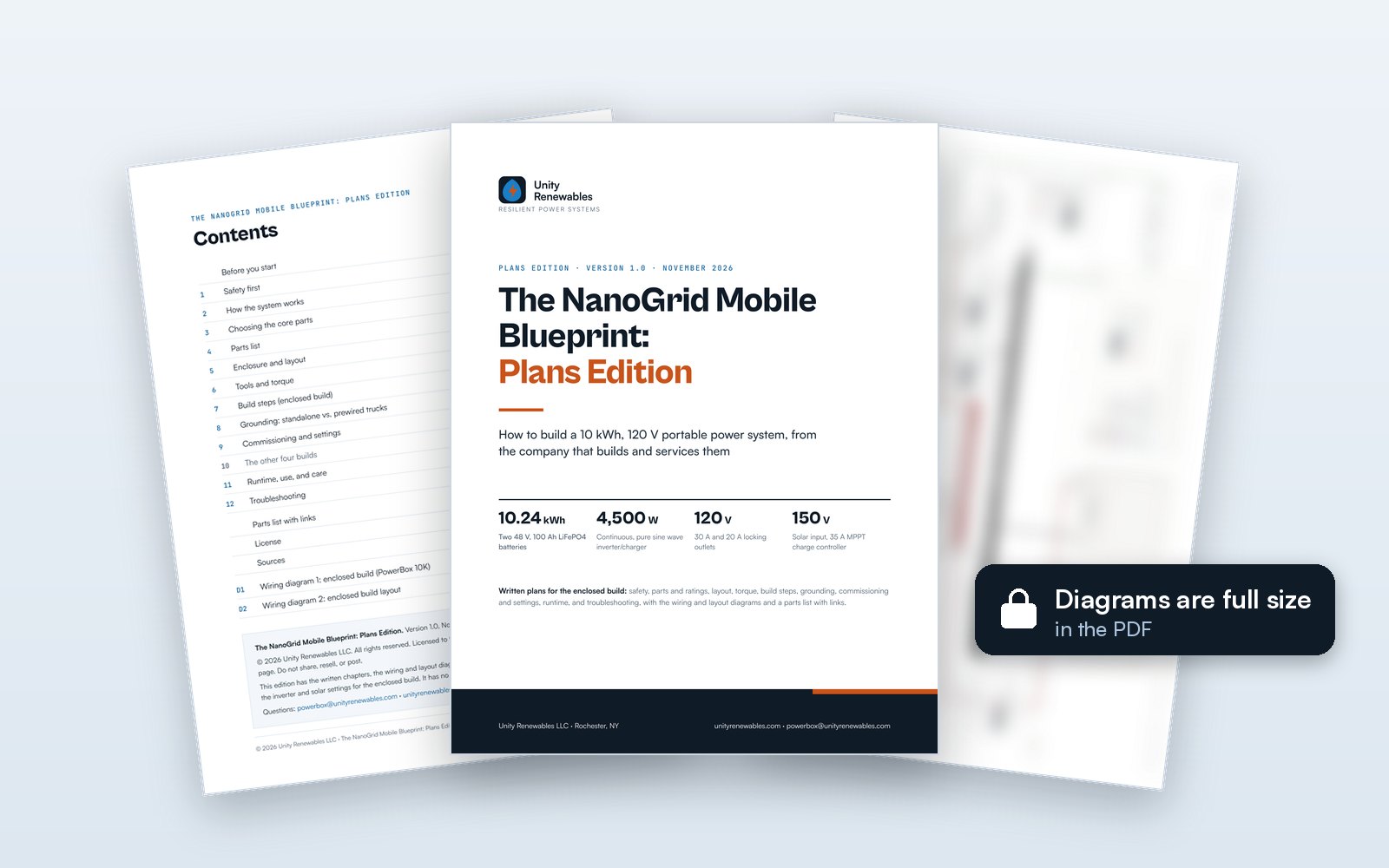
The Plans Edition cover and contents. Diagram pages are blurred here; the PDF has them full size.
Three editions
Start with the plans. Step up when you need more.
Start here
Plans Edition
For experienced builders who work from written steps and diagrams.
$67one-time
Chapters 1 to 9, 11, and 12 as a PDF, without the build photos
Wiring and layout diagrams for the enclosed build
The parts list, with links and budget picks
Torque table, inverter and solar settings, and troubleshooting
Opening soon. We are photographing and filming a new PowerBox build for the Blueprint now. Follow us on Instagram or Facebook for updates.
Instant download after checkout. Digital sales are final except where applicable law requires otherwise. Checkout is handled by Payhip. We never see or store your card details.
Everything else
Design your own system with the NanoGrid System Designer.
The Blueprint editions are written around the PowerBox 10K. For anything else, pick any batteries, inverter, charge controller, and solar panels, at 12, 24, or 48 V, for a cart, van, truck, trailer, job site, event, home backup, or a box of a different size. The Designer sizes every wire, fuse, breaker, switch, and bus bar, then gives you the full list of parts to build it.
Wire sizes from ampacity, voltage drop, and each maker's minimum
Fuses, breakers, the battery switch, and bus bars, with the reason for each size
The AC side: inlet, breakers, outlets, and wire
Checks that flag a part that is too small or a setting out of range
A one-line diagram, a printable design packet, and a full parts list with lugs, cable lengths, and tools
Every rule linked to its source, from NEC tables to the makers' manuals
Not included
Step-by-step build instructions, build photos, or build-along videos
Parts or additional measured Photo Plan builds
Torque values for each connection. Use each maker's manual.
The online edition is included in the Complete Builder Kit. It runs in your browser and needs an internet connection. Payhip emails your key after checkout. Sign in to the online Designer.
The Offline Edition is $219 one-time and runs on one computer in one browser profile after activation. Both editions include one measured Photo Plan build, with 12 months of edits and new exports after unlock. Additional measured builds are $29 each. Retailer links and first-time Photo Plan unlocks need internet. Read the Designer license terms.
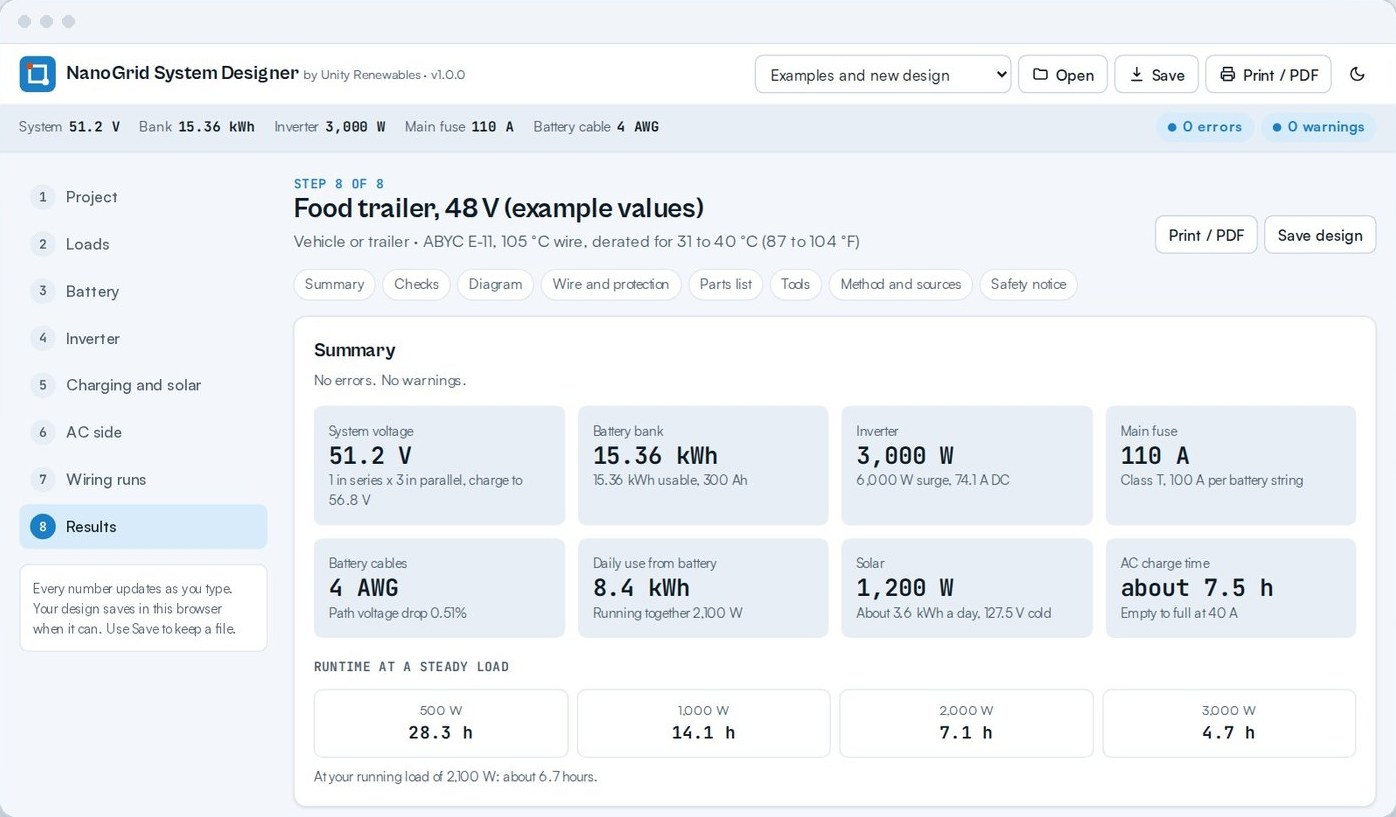
The Designer's results screen for an example 48 V food trailer. Every number updates as you change parts.
Is it a fit
Built for hands-on people.
A good fit if you
Are comfortable with hand tools, a multimeter, and a torque wrench
Want to understand, build, and service your own power system
Run a food truck, cart, event, or mobile service business and like to build your own equipment
Are a contractor, electrician, or installer who builds systems for customers
Not the right fit if you
Would rather have it done for you. The PowerBox 10K is built, delivered, and set up for you.
Want to connect a system to a building without hiring a licensed electrician
Need a UL 9540-listed home battery system for a permanent install
From the shop that builds them
Written from units working in the field.
About 15 PowerBox units are working today on food trucks and mobile businesses from Nashville, TN to Westborough, MA. What we have learned building, delivering, and servicing them is in the Blueprint.
This thing has been an absolute lifesaver for me and my business. Save yourself the money and trouble.
Mad PotatoesNashville, TN
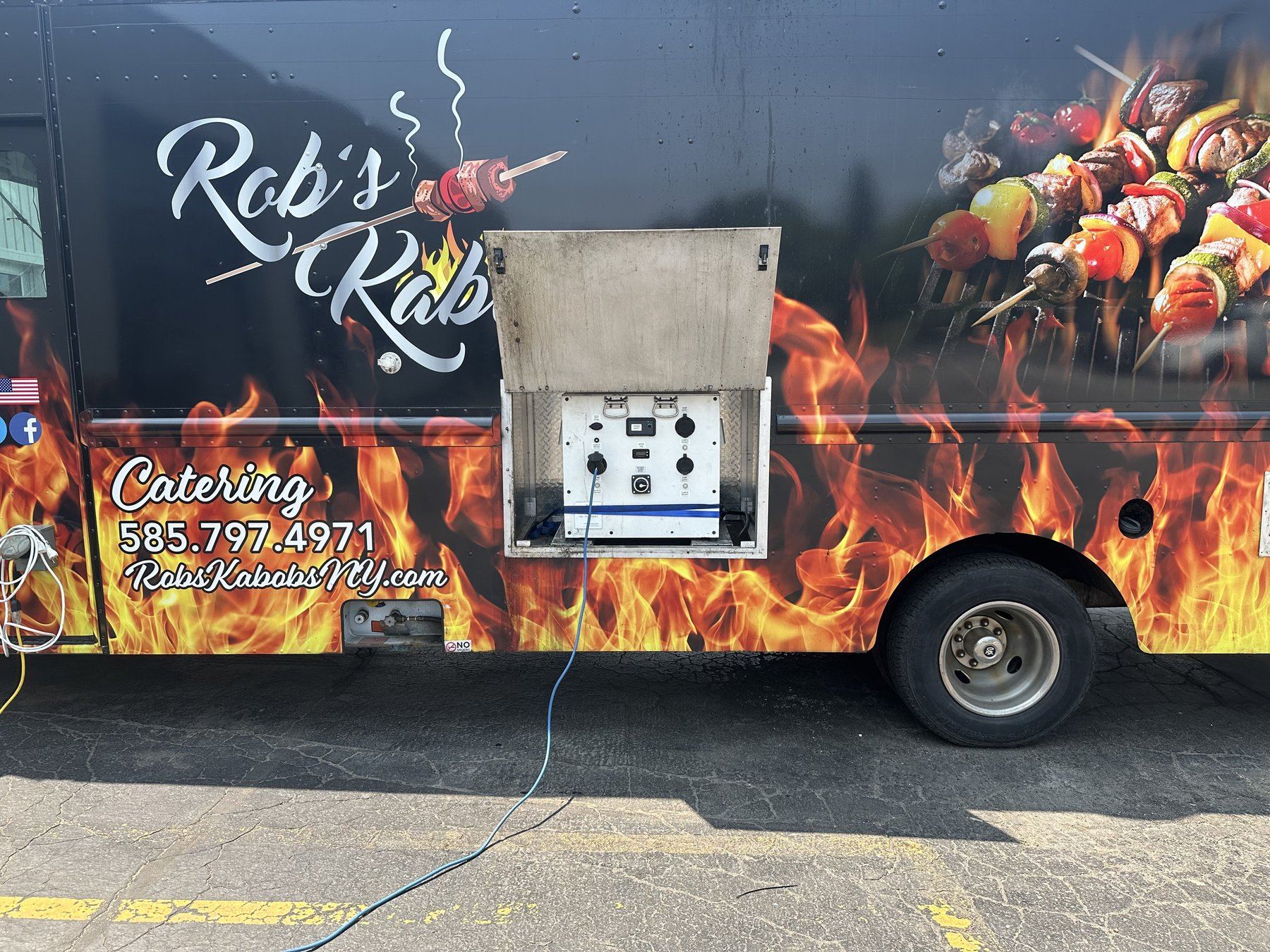
Makes my life so much easier, not having to worry about a generator. Just pull up to an event and everything is still running. Been a lifesaver to me and my business.
Rob's KabobsRochester, NY
Read this before you buy
These are lithium battery systems, at 12, 24, or 48 V, with 120 V AC outputs. Built or used carelessly, they can cause fire, electric shock, serious injury, or death.
Chapter 1 of the Blueprint sets out the safety rules before the first wiring step, and the Designer shows a safety notice with every design. Read them, and the manual for every core part, before you buy anything.
Use listed components, and use each one only within its printed ratings.
Any connection to a building's wiring must be made by a licensed electrician, with a permit, through a listed transfer switch or interlock.
A permanent home battery install may need a UL 9540-listed system. Check with your building department first.
The Blueprint and the System Designer are educational. You are responsible for following the codes that apply where you live and use the system, and for hiring a licensed electrician where required. Unity Renewables does not inspect or certify systems built from the Blueprint or designed with the System Designer.
Questions
Before you build.
If you want to build the PowerBox 10K, the 10 kWh, 48 V rolling box we build in our shop, start with the Plans Edition of the Blueprint. For anything else, like a van, truck, trailer, cart, home backup, or a box of a different size, use the NanoGrid System Designer. The Designer sizes and lists your parts and includes one measured Photo Plan build, but it does not include build steps, build photos or videos, or the PowerBox 10K plans. The Complete Builder Kit includes both.
A step-by-step guide to building a 10 kWh, 48 V LiFePO4, 4,500 W, 120 V portable power system, with a parts list, wiring diagrams, torque values, and inverter and solar settings. You download it as a PDF after checkout. Each copy is licensed to the person who buys it.
The Plans Edition has the written steps, wiring diagrams, parts list, torque table, and settings for the enclosed build. The Blueprint adds step-by-step photos from a new PowerBox build. The Complete Builder Kit adds the other four builds, build-along videos of the PowerBox build, and the NanoGrid System Designer for any other build.
A tool to size and check battery power systems, draw a one-line diagram and make a parts list. The $79 Online Edition requires internet and works in one browser profile at a time. The $219 Offline Edition runs on one computer in one browser profile after online activation. Either edition includes one measured Photo Plan build with 12 months of edits and new exports after unlock. Additional measured builds are $29 each. The Designer does not replace a licensed electrician or your local code.
Yes. The $219 Offline Edition runs on one computer in one browser profile after online activation. Use the same file location and browser profile, and save your project files separately. New Photo Plan unlocks and external retailer links still need internet.
Not for the portable builds, if you are comfortable with hand tools, a multimeter, and a torque wrench, and you follow every step. Any connection to a building's wiring must be made by a licensed electrician, with a permit, through a listed transfer switch or interlock.
The enclosed build uses a MidNite Solar Little Rosie MNLR4548RE inverter/charger, two 51.2 V, 100 Ah LiFePO4 batteries in parallel, and a Victron SmartSolar MPPT 150/35 charge controller. The parts list gives the rating each part needs, so you can substitute.
The parts list shows the current price of each part, with a budget pick where one exists. The two batteries and the inverter/charger are the largest costs. Prices change, so buyers get a live parts list with current links.
From shore power, a generator, or a household outlet through the inverter's built-in charger, and from solar panels through the charge controller. Chapter 9 gives the settings for each source.
Yes. The vehicle install in the Complete Builder Kit uses MidNite's mobile inverter/charger, the MNLR3648M, with steps for vehicle wiring, mounting, and grounding.
For available editions, Payhip sends your receipt and access instructions after checkout. Blueprint editions are files; Designer editions and the Photo Plan use license keys.
Digital sales are final except where applicable law requires otherwise. If a file or license key is missing or does not work, email powerbox@unityrenewables.com for help. This policy does not limit your mandatory consumer rights.
Not today. If we add affiliate or dealer links later, we will label them clearly.
Yes. The PowerBox 10K is hand-built in Rochester, NY and load-tested before it ships, with delivery and setup within a 6-hour drive of Rochester, NY.
Watch the build
A new PowerBox, built on camera.
We are building a new PowerBox from the Blueprint and posting the build as it happens. Follow along on Instagram and Facebook.